Monographs
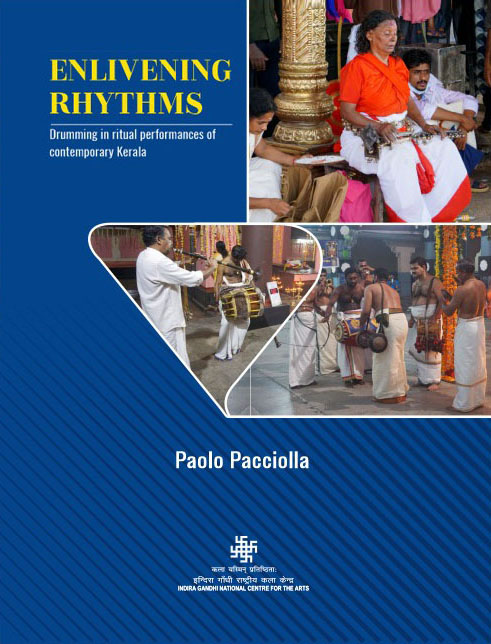
2024 – Enlivening Rhythms. Drumming in Ritual Performances of Contemporary Kerala (Indira Gandhi National Centre for the Arts)
The book is an ethnomusicological study focused on central Kerala, particularly the Thrissur district and surrounding areas. This region has a significant presence of the Nambudiri Brahmin community and their temples, which have greatly influenced the cultural and ritual practices of other local communities who are devoted to goddess worship. At the core of these rituals is the pivotal role of drums, which occupy a prestigious position among Kerala’s musical instruments and characterize its sonic landscape.
The study examines the sacred musical repertoire performed in Brahmanical temples as well as shrines devoted to goddess worship, tracing the continuities and discontinuities between these contrasting beliefs and rituals from the perspective of music and drumming. It takes into account the socio-historical aspects that shaped Kerala’s history, investigating the beliefs, origins, and evolution of different ritual performer communities and their contributions to contemporary ritual practices and the role of drumming within them.
Major ritual compositions, with a focus on pieces that had not been previously studied, are analysed employing a novel methodology that approaches the entire repertoire as embodied knowledge transmitted through practice. Through musical examples, the visual content and ritual meaning of these compositions is elucidated.
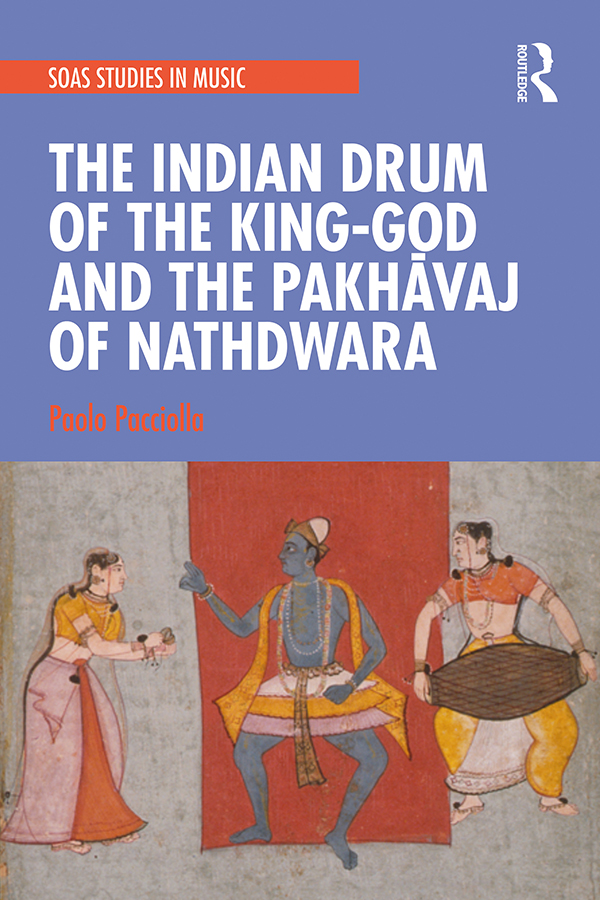
2020 – The Indian Drum of The King-God and the pakhāvaj of Nathdwara, Routledge (SOAS Studies in Music)
The book studies the evolution of the ancient drum mṛdaṅga into the pakhāvaj, crossing more than 2,000 years of history. While focusing on the Nathdwara school of pakhāvaj, the author joins ethnographic, historical, religious and iconographic perspectives to argue a multifaceted interpretation of the role and function of the pakhāvaj in royal courts, temples and contemporary stages. Furthermore, he offers the first analysis of the visual and narrative contents of its repertoire.
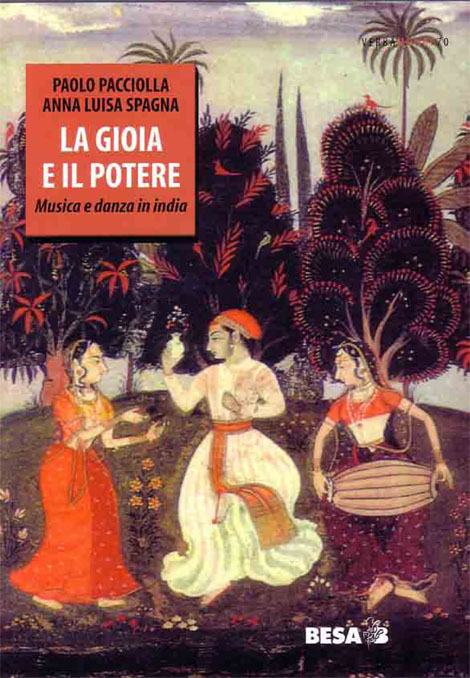
2008 – La gioia e il potere. Musica e danza in India, Besa, Nardò.
“La ricerca musicale e coreutica indiana è una delle chiavi fondamentali per comprendere l’arte indiana e le sue sottili implicazioni simboliche e sacre. L’opera si propone di investigare tali tematiche a più livelli, ripercorrendo l’iter storico fin dalle origini e ricostruendo gli sfondi naturali e urbani delle esecuzioni, con l’emergere del tempio come luogo di unificazione delle varie arti…” Marilia Albanese
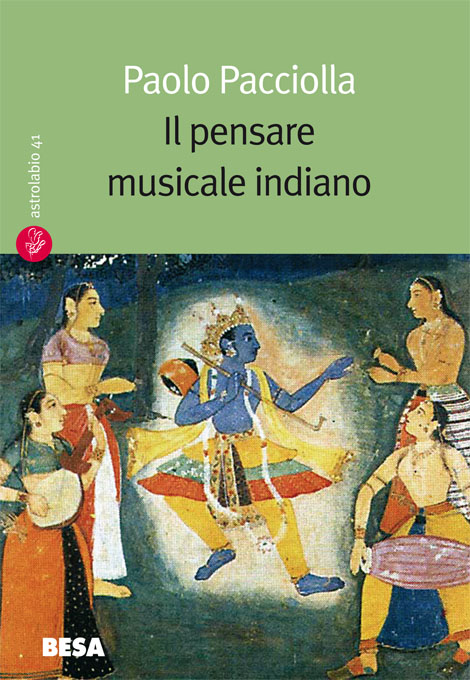
2005- Il pensare musicale indiano, Besa Editrice, Nardò.
“Il lavoro di Paolo Pacciolla va degnamente ad affiancarsi ed arricchire il breve, ma pur agguerrito, manipolo di studiosi italiani che hanno cercato nel discorso sull’India la conferma di intuizioni che, in Occidente, non avrebbero mai potuto verificare. Se è vero che il tempo è buono e onesto giudice, questo fiorire di intenti testimonierà giustamente dell’onestà di chi ha cercato, rischiando di se stesso, conforto altrove.” Roberto Perinu
Peer reviewed essays
2023 – The musical journeys of a goddess. An integrative analysis of drumming, dancing, and ritual in the contemporary Kallaṯṯakuṟuppu tradition of kaḷameḻuttu pāṭṭu of central Kerala. Analytical Approaches to Music of South Asia Journal, Vol. 1.
southasia.iftawm.org/volumes/volume1/pacciolla/
2022 – Rain of Life, Rain of Music: Music as Life Power in Indian Thought and Contemporary Musical Traditions. South Asia: Journal of South Asian Studies. https://doi.org/10.1080/00856401.2022.2121464
2021 – Bodies of Silence, Floods of Nectar. Ritual Music in Contemporary Tantric Brahmanical Temples of Kerala. Yale Journal of Music and Religion, Vol. 7, No.2.
https://elischolar.library.yale.edu/yjmr/vol7/iss2/2/
2021 – The Brimming Vessel: An Analysis of the Ritual Repertoire of the Miḻāvu from a Tantric Perspective. Analytical Approaches to World Music Journal, Vol.9, No 1.
https://www.aawmjournal.com/articles/2021a/Pacciolla_AAWM_Vol_9_1.html
2003 – Metafisica e cosmologia del suono, In Corso d’Opera, Università degli Studi di Lecce.
Forthcoming
2021 – Paolo Pacciolla. Traditional music of Salento. Societies, Identities, Politics. Proceedings of the webinar Traditional music in different cultures: Challenges and opportunities in the changing global scenario, Department of Music, University of New Delhi. Vageshvari, Journal of the Department of Music, University of Delhi.
Conferences publications (proceedings)
2020 – Suoni in azione. L’universo acustico del Kūtiyāṭṭaṃ contemporaneo. Proceedings of the Conference: Linguaggi, esperienze e tracce sonore sulla scena, University of L’Aquila.
2004 – Cosmogonie musicali: rappresentazioni dell’universo nella musica indiana, Studi Linguistici e Filologici Online 5.2, Atti del XII Convegno A.I.S.S., Parma, settembre 2004, http://www.humnet.unipi.it/slifo/vol5.2/Pacciolla5.2.pdf
2002 – La via mistica del Mridang-Pakhawaj, Atti dell’Undicesimo Convegno Nazionale di Studi Sanscriti, Milano.
Other essays and articles
2010 – Dare voce alla morte. Antiche idee sulla musica, Poesia e Spiritualità. Semestrale di ricerca transdisciplianare. Dossier Musica, (Anno II, Numero 5), Passagem Sem Guarda Edizioni, a cura di Donatella Bisutti.
2010 – (traduzione a cura di Paolo Pacciolla) Storia dell’India. Dai primi regni islamici alla costituzione dell’impero inglese, C.B.Asher – C. Talbot, Controluce Edizioni, Nardò.
2008 – Infinite danze nascoste, Melissi – Le culture popolari, 16/17, Besa, Nardò.
2007 – Ghetonia. La tradizione e la creatività, Melissi – Le culture popolari, 14/15, Besa, Nardò.
2007 – La musica e la via. Il tambur e gli Yaresan, Melissi – Le culture popolari, 14/15, Besa, Nardò.
2006 – Tamburi e simboli. Strumenti musicali e identità, Melissi – Le culture popolari, 12/13, Besa, Nardò.
2005- Tradizione/ innovazione: contrapposizione o complementarità?, Melissi – Le culture popolari, 10/11, Besa, Nardò.
2004 – La musica Indiana: una ‘via’ melodiosa per la libertà, Melissi – Le culture popolari, 8/9, Besa, Nardò.
2004- Kalamukha, il grande divoratore, Mimose, Lecce.
2003 – Una tradizione in movimento. La musica persiana nel continuo rinnovamento delle forme e Il calice dell’ebbrezza ritmica, Melissi – Le culture popolari, 6/7, Besa, Nardò.
 Paolo Pacciolla